

Project
ELSAfloor - Development of an application-ready test method for quantifying and classifying the electrostatic charge of floor coverings
Goal: The quality of floor coverings depends largely on their electrostatic behavior. High-quality coverings are characterized by the fact that they generate no or only very little electrostatic charge when walked on. Until now, this property has been verified in accordance with standards by means of personnel walking tests in accordance with EN 1815 and ISO 6356. However, this method has significant disadvantages: Since humans act as testers, numerous individual factors influence the measurement results, which significantly limits their comparability and reproducibility. The aim of the project was therefore to develop a mechanical walking device and the associated measurement methods for various product groups in order to determine the electrostatic charge of floor coverings objectively, reproducibly, and in a practical manner.
Problem: The main problem was the lack of standardization in the testing methods used to date. Human differences in movement, weight, speed, and walking technique lead to considerable variations. As a result, the measurement results from personal walking tests are not reliable enough to provide a clear classification of floor coverings in terms of their electrostatic properties. A test method and the associated test procedure were therefore needed that would eliminate human influencing factors and at the same time simulate practical load situations.
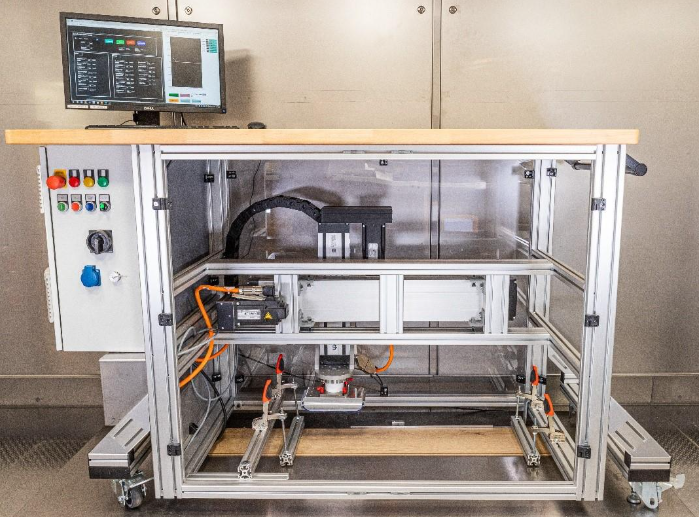
Solution: The E-Tester was developed to solve this problem. It is a semi-automatic walking device that performs standardized movements with a test foot. This test foot has a rectangular surface area of 165 cm² and is equipped with an EPDM sole that serves as a friction partner for the floor coverings being tested.
The movements of the test foot can be adjusted using a configurable control tool. Important parameters such as pressure force, approach speed, and separation movement can be specified precisely, ensuring reproducible results. Measurement methods have been developed for various types of floor coverings, including laminate, SPC, LVT, textile coverings, and artificial turf, which record the maximum possible charging stresses in the case of worst-case movement sequences. The methods were adapted for each product group in order to obtain comparable results and thus a valid classification of the goods despite material-related differences.
During these movements, stress curves are recorded, the waveform and rises of which enable a precise analysis of the charging dynamics. On this basis, a classification into antistatic and non-antistatic can be made.
Results: At the end of the project, a functional laboratory setup of the E-Tester is available. The results achieved show a method error of between 10% (for laminate) and 20% (for MMF coverings), a repeatability of 0.3–0.5 kV, and a reproducibility of approximately 1.0 kV. In addition, a test specification for various product groups was developed, which enables reproducible tests with consistent results.
The E-Tester thus meets the requirements for a reliable test method. In addition, several digital user interfaces have been developed that can be flexibly adapted to user requirements.
However, there is still room for optimization, particularly in terms of full automation and precise force control of the test foot. Only then will it be possible to transfer the laboratory setup to an industrial-grade measuring device.
Funding program and project number
INNO-KOM 49MF210110
Supported by:
Duration
01.11.2021 – 31.03.2025
Print Project partners and/or other research institutes
IHD – Institut für Holztechnologie Dresden gemeinnützige GmbH, Zellescher Weg 24, 01217 Dresden
Acknowledgement
The INNO-KOM project “Development of standardized scuffing materials and a reference material as well as adapted test methods for the micro-scratch resistance of coatings (µ-scratching)” 49MF210012) is funded by the Federal Ministry for Economic Affairs and Energy as part of the INNO-KOM innovation competence program.