

Project
Acoustic yarns - Analysis of influencing factors for the development of acoustically effective yarns of textile structures
The aim of the research project was to use a systematic analysis of influencing factors to enable the effective and efficient development of innovative combination yarns with an acoustically effective structure. This significantly expands the potential of acoustically active textiles.
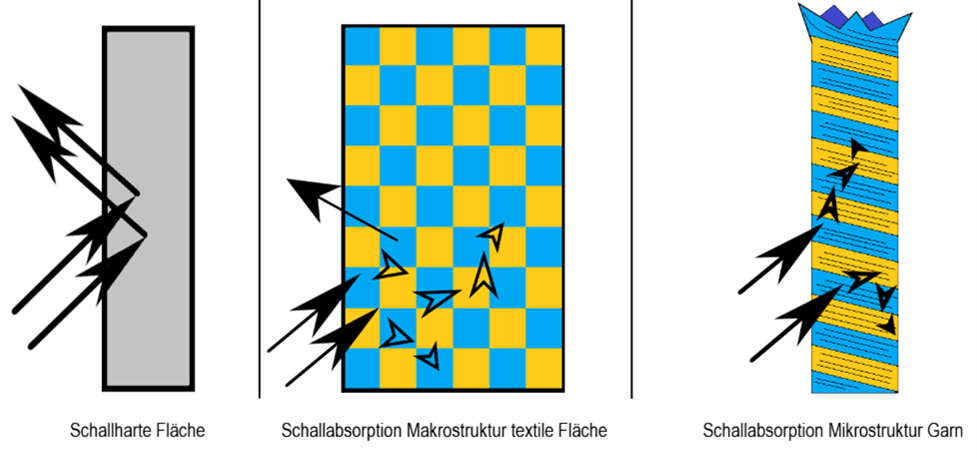
Half of all workplaces in Germany are office-based. Reducing noise in indoor spaces is therefore of great importance for comfort, work performance and health. All large surfaces in a room (e.g. ceilings, walls, floors, cabinet fronts or backs) influence the acoustic properties of the entire room by their material and construction. In many cases, particularly in multi-desk or open-plan offices, textiles or textile components in the form of floor coverings, curtains, coverings for acoustic elements or wall coverings contribute to achieve the acoustic specifications of the Technical Rules for Workplaces. A systematic analysis was required for the targeted development of yarns and textile surfaces with regard to a required sound absorption coefficient, to address specific frequency ranges and to ensure the efficient utilisation of the materials used. To this end, it was also necessary to develop a test method for the acoustic properties of yarn structures.
Following the definition of a requirements profile, the selection of use cases and the yarn materials to be used, a novel test method was developed to determine the acoustic performance of yarn structures. Various yarn constructions were developed and tested using this novel method. Textile fabrics were produced as examples from the combination yarns and also subjected to acoustic testing. The results were incorporated into a mathematical model. There was a continuous iterative improvement process between the development of the test method, the yarn and fabric construction, and the model. The results were transfered into the production of defined demonstrators to validate the results and to derive recommendations for the parameterisation of the design of acoustically effective yarns and fabrics.
It has been demonstrated that the newly developed test method is suitable for effectively differentiation between the yarns supplied by PA in terms of their acoustic properties. Fundamental correlations between the yarns’ construction parameters and their acoustic performance have been identified. Based on these results, novel blended yarns were developed and investigated. Whilst the correlations found were confirmed here, no significant potential for improved acoustic performance has yet been demonstrated.
The investigation of the textile fabrics produced from the existing and newly developed yarns provided further insights into the exploitation of the acoustic potential of different yarns in various fabric constructions. It was demonstrated that these results can in principle be transferred into a mathematical model; however, due to the still limited amount of data, this model is not yet robust.
The results were qualitatively validated using two demonstrator-scale samples in the echo chamber, revealing that systematic differences arise here due to the different measurement principles. The measurement technology and evaluation methodology developed now provide the basis for gradually expanding the existing database by further experiments and refining the models.
The final report on the research project is available for download as part of the TFI publication series.

Project partners and/or other research institutes
Consortium:
- ALKEGEN Insulation-Sealing-Construction ISC, Fulda
- AQUAFIL Deutschland GmbH, Königstein im Taunus
- Gebrüder Aurich GmbH, Radevormwald
- Gerriets GmbH, Umkirch
- DAS TEPPICHWERK, Hameln
- Heytex Bramsche GmbH
- HORBACH Sachverständigenbüro, Aachen
- Kinnasand GmbH, Hamburg
- Object Carpet GmbH, Krefeld
- Pongs Group GmbH & Co. KG, Pausa-Mühltroff
- Saurer Technologies GmbH & Co. KG, Krefeld
- Trevira GmbH, Hattersheim
- Tuchfabrik Willy Schmitz GmbH & Co. KG, Mönchengladbach
- Wirth Fulda GmbH, Fulda
- Zwickauer Kammgarn GmbH, Wilkau-Haßlau
Acknowledgement
The IGF project “Analysis of factors influencing the development of acoustically effective yarns for textile structures (Acoustic Yarns)” 23058 N1 of the Forschungskuratorium Textil e.V. research association, Wallstraße 58/59, 10179 Berlin, was funded by the Federal Ministry for Economic Affairs and Energy as part of the programme for the promotion of industrial collaborative research and development (IGF), following a resolution of the German Bundestag.