

Project
STP – Commercially cleanerable, sensory tufting structures for patient monitoring
Objective The objective of the project is to develop sensor tufting structures for textile applications in the healthcare sector that can reliably detect changes in temperature, humidity, and pressure while also meeting the haptic, climatic, and mechanical requirements for bed sheets. To this end, tuftable sensor yarns with a textile feel are to be developed and integrated into tufted structures that remain functional even after repeated commercial laundering. In addition, the development of appropriate measurement, evaluation, and testing methods is planned in order to make the sensor functions reproducible and practical for use.
Problem
The increasing shortage of nursing staff combined with a rising number of people in need of care is leading to high workloads, nursing errors, and avoidable health problems such as pressure ulcers. Digital assistance systems could relieve the burden on nursing staff and improve the quality of care. However, the use of smart textiles has so far failed due to their lack of resistance to the mandatory commercial disinfection procedures. Sensitive contact points in particular prevent reliable and economical use in everyday care.
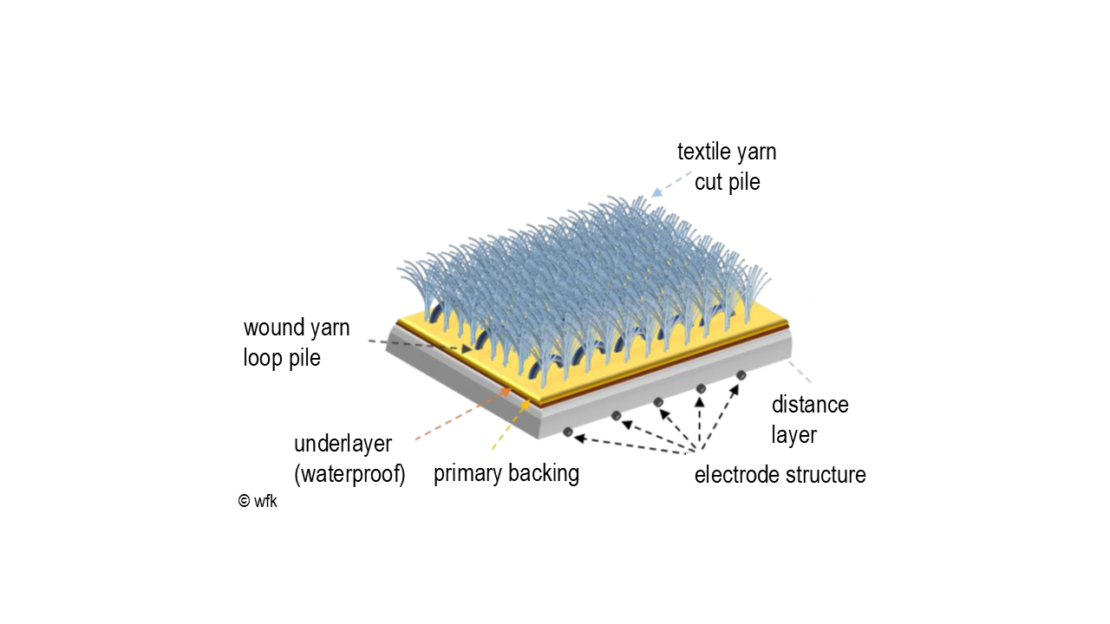
Solution approach First, a sensor yarn with a conductive core and textile sheath is developed, whose electrical properties, processability in the tufting process and resistance to commercial cleaning processes are investigated and optimised. Building on this, tufting structures with integrated sensor yarns will be developed, with pile heights, yarn spacing and tufting parameters specifically adapted to sensory, haptic and climatic requirements. The pile tufts will be integrated using thermobonding or hot melt processes. The tufting structures will then be bonded with an electrode-integrated spacer layer to enable reliable pressure detection. At the same time, measurement and analysis methods for recording temperature, humidity and pressure are being developed and converted into algorithms. The functional samples are tested under realistic conditions, commercially cleaned several times and iteratively optimised before the results are documented and prepared for transfer into application.

Project partners and/or other research institutes
wfk – Cleaning Technology Institute e.V. (Forschungseinrichtung 1)
Acknowledgement
YOUR CONTACT PERSON