

Project
EcoCoat - Detachable bio-based coating system for the lamination of textiles using the example of textile floor coverings
The Need
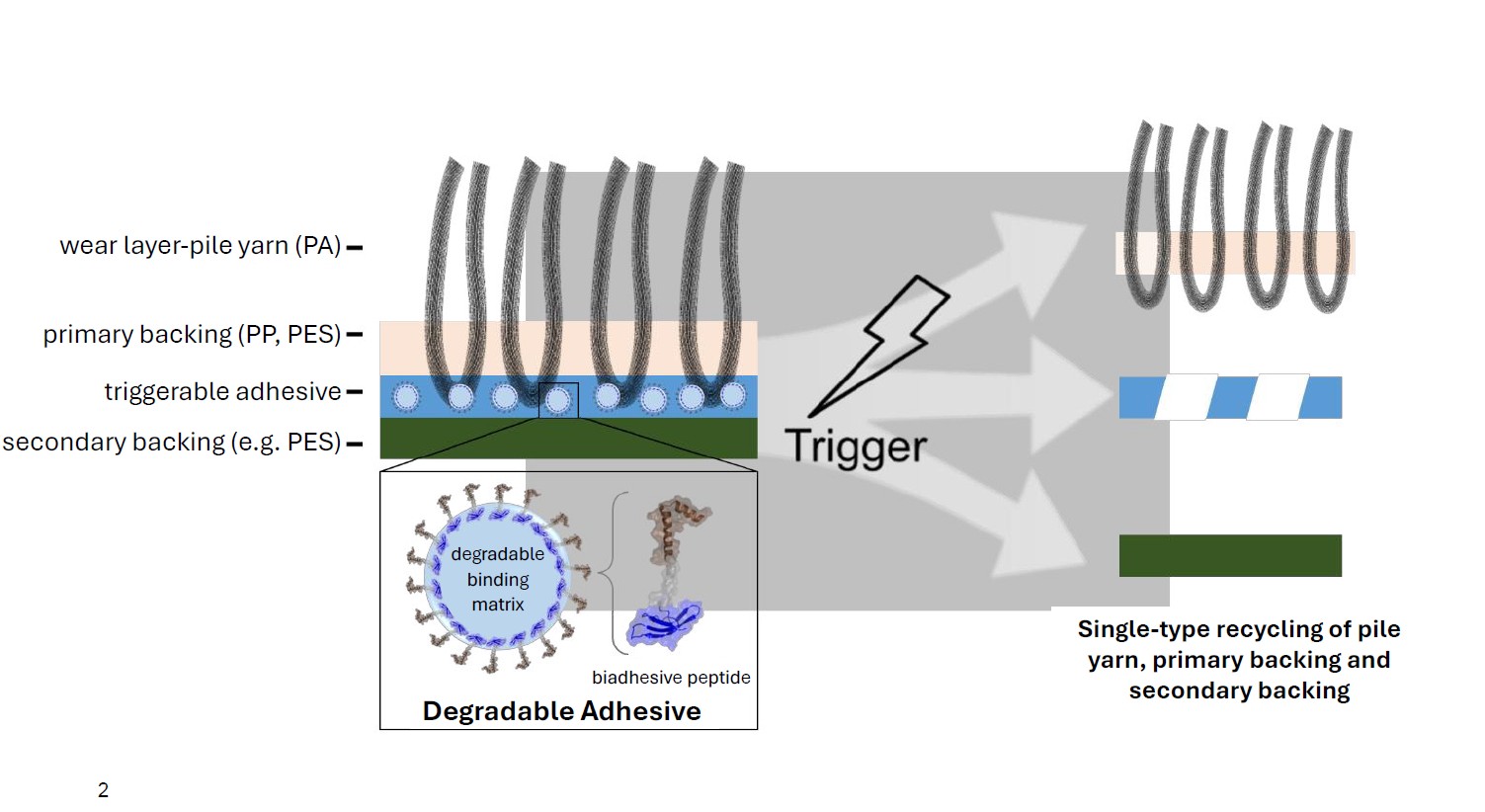
75% of the textile floor coverings used in Germany are manufactured using the tufting process. A latex coating is applied to the back (pre-coating) to anchor the pile yarns in the primary backing. In the second coating step, a textile backing (laminating coating) is applied.
When recycling textile floor coverings, the separation of the different materials into pure fractions is a central problem. One solution here is to remove the coating at the end of the product's useful life.
Solution
At DWI, a tailor-made peptide adhesive with strong bonding and stimuli-responsive properties was developed for removal. At TFI, the production technology for applying and drying the coating system was developed. Functional samples for benchmark comparisons were also developed here. Following the development of a separation and recycling concept, the coating system was evaluated in terms of its economic and ecological benefits. The transferability of the new coating system to needled textile floor coverings was demonstrated.
Results
The EcoCoat adhesive developed in the project meets the objectives of the application in terms of the use of bio-based raw materials, adaptation of the adhesive properties to the materials to be bonded, dissolution of the adhesive via a trigger and minimal emissions in the processed state. The adhesive system thus represents a highly interesting bonding solution with resulting advantages such as improved recyclability of the products manufactured from it. The application example of ‘textile floor coverings’ considered in this project is characterised by a comprehensive catalogue of tests and evaluations laid down in standards for describing the product properties. These flooring-specific tests showed that further development is needed in terms of mechanical properties for the use of the EcoCoat adhesive. In its current form, the adhesive is too brittle for use in textiles. This needs to be further developed in future work.
The economic and ecological assessment also highlighted further potential for future research work with regard to the EcoCoat adhesive: a reduction in water content is urgently needed, as the CO2 released during the drying of the adhesive in particular significantly reduces the ecological advantages due to the recyclability of the products manufactured with it.
Furthermore, the research results show that the use of water-soluble adhesives for laminating and bonding is one approach to improving the recyclability of textile composite systems.
The final report on the research project is available as part of the TFI publication series.

Project partners and/or other research institutes
2. Research Organisation:
DWI Leibniz Institut für Interaktive Materialien e. V.
Project Advisory Committee:
- Aachen Proteineers
- BRAIN Biotech
- Celabor
- Findeisen
- Freudenberg PM
- Halbmond Teppichwerke
- NUNAFERM
- Pfeifer & Langen
- Pultex
- SensUP
- SeSaM Biotech
- Uzin Utz
- Weseler Teppich
- Weserland
- Windmöller
Acknowledgement
The IGF project “Detachable bio-based coating system for the lamination of textiles using the example of textile floor coverings (EcoCoat)” 22593 BG of the Research Association Forschungs-kuratorium Textil e.V., Reinhardtstraße 14-16, 10117 Berlin is being funded by the Federal Ministry of Economics and Climate Protection via the AiF within the framework of the programme for the promotion of joint industrial research and development (IGF) based on a resolution of the German Bundestag.