

Project
BioAntiStat - Biobased recyclable antistatic coating for textiles using the example of textile floor coverings

Together with DWI, TFI is developing antistatic coatings based on biomass (pectins). This coating permanently prevents electrostatic charging through complexed ions and adsorbed water molecules.
Electrical discharge caused by friction on non-conductive textiles is a particular problem in winter when humidity is low. Currently, environmentally harmful antistatic agents are added to antistatic coating systems for textile floor coverings.
For the new coating system, modified pectins as well as a suitable application and drying technique are being developed.
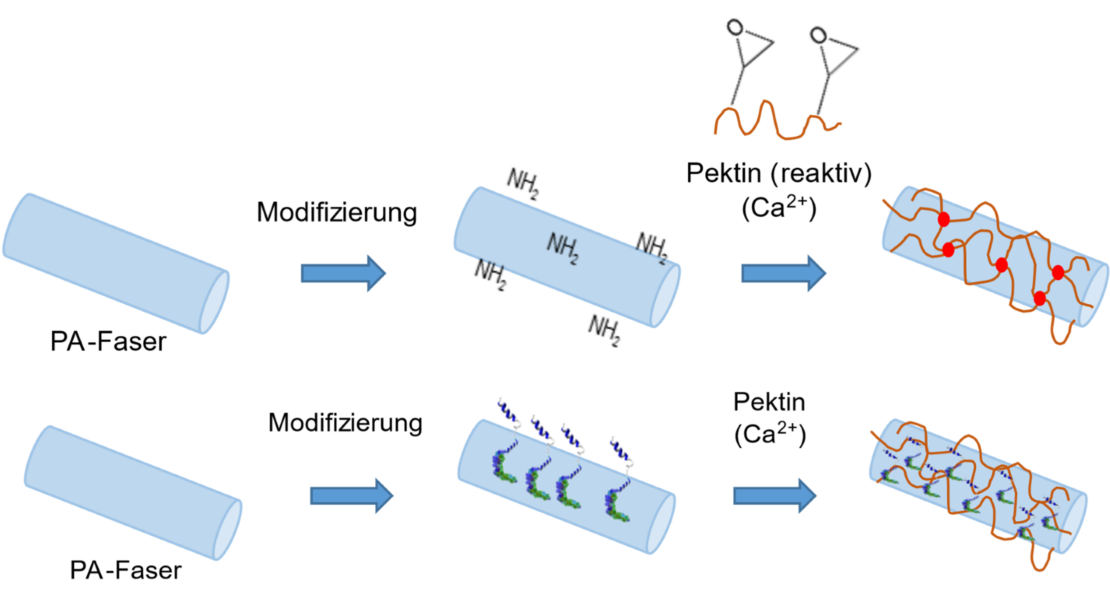
The goal of the project is to develop a bio-based permanent antistatic coating based on pectins for textiles to prevent charging effects, using textile floor coverings as an example. The permanent bonding of pectin to the fibers is achieved through anchor peptides.
The effect of electrical discharge is particularly noticeable in winter due to dry indoor heating air. This occurs through electrostatic charges generated when walking, as the contact between shoe soles and the floor creates friction. When a charged person touches other people or conductive objects, a high discharge intensity can lead to an electric shock. Besides being an unpleasant sensation, this can also damage electronic devices. For this reason, floor coverings in public and commercial spaces must meet high antistatic requirements. In textile floor coverings made from synthetic fibers, antistatic fibers are often blended in to dissipate electrostatic charges. Horizontal charge distribution is achieved through antistatic additives in latex-based coatings. However, these coatings hinder the recycling process of floor coverings. Residues from such coatings interfere with the depolymerization process, which is why approximately 97% of textile floor coverings in Germany are thermally disposed of.
To increase the recycling rate, new product designs are needed. The thermobonding process can replace the application of primers by utilizing the thermoplastic properties of synthetic fibers. As a result, the horizontal dissipation of charges needs to be redesigned.
Water can help neutralize occurring charges. A biopolymer particularly capable of binding water and available as an agricultural byproduct in Germany is pectin. Pectin is biodegradable and widely used in the food industry as a vegan gelling agent. In this project, a concept will be developed for integrating pectin into the textile floor covering system (primary backing and/or use surface). At the end of its service life, the coating should be detachable from the textile floor covering so that both the pectins and textile materials can be recycled.
Project partners and/or other research institutes
- ALKEGEN
- BARNET EUROPE W. Barnet GmbH & Co. KG
- BWF Tec GmbH
- Filzfabrik Fulda GmbH
- Grüne Erde GmbH
- Hamelner Teppichwerke GmbH & Co. KG
- Ibena Technische Textilien GmbH
- Insulation-Sealing-Construction ISC
- Industrieverband Veredlung – Garne – Gewebe – Technische Textilien e.V. (IVGT)
- Kayser Filtertech GmbH
- Mehler Texnologies / Freudenberg Object Carpet GmbH
- Pfeifer & Langen GmbH & Co. KG
- Schöpp Polymer Carpet GmbH
- Weitmann & Konrad GmbH & Co. KG
- Weserland GmbH
- Weseler Teppich GmbH & Co. KG
- Wölfel GmbH & Co. KG

Acknowledgement
We would like to thank the Federal Ministry of Economics and Climate Protection (BMWK) and the Industrial Collective Research (IGF) for their project funding!
YOUR CONTACT PERSON
