
ALPA Publication
Authors: Lemm, J. (TFI), Reuther, S. (TFI), Groten, R. (FTB), Rohleder, E. (FTB), Geerkens, S. (Evonik), Ziegler, A. (Evonik)
In the ongoing IGF research project “Alternative polyamides with reduced global warming potential for textile floor coverings with a monomaterial upper layer (ALPA)” (IGF 23385 N), the Institute for Floor and Room Systems at RWTH Aachen University (TFI) and the Research Institute for Textiles and Clothing (FTB), together with a project committee comprising 15 industry representatives from across the entire value chain, are investigating the suitability of polyamide 12 (PA 12) as a sustainable alternative to conventional polyamides (PA 6/PA 6.6). The aim is to develop a monomaterial upper layer for textile floor coverings that offers improved recyclability, increased dimensional stability, and reduced global warming potential. The project will run from October 1, 2024, to September 30, 2026.
PA 12 stands out from PA 6 thanks to its significantly lower global warming potential of 6.9 kg CO₂ equivalent per kilogram of polymer (PA 6: 9.1 kg CO₂ equivalent/kg) and considerably lower moisture absorption of 0.7% at 23°C and 50% relative humidity (PA 6: 2.6%). These properties result in increased dimensional stability and reduced susceptibility to soiling, which has a positive effect on both the usability and service life of textile floor coverings. In addition, the lower melting temperature of PA 12 (178 °C) compared to PA 6 (220 °C) enables a significant reduction in energy consumption during fiber production in the melt spinning process and during pile tufting in the thermobonding process.
As part of the research project, Evonik Operations GmbH provided several PA 12 grades. These materials were successfully processed for the first time into ribbon yarns and BCF (bulked continuous filament) yarns using the extrusion spinning process. The PA 12 grade with lower viscosity in particular showed promising spinning and processing properties for both yarn types. Another grade with increased amino group content was investigated and showed advantages in terms of dyeability, but proved to be more challenging in the spinning process.
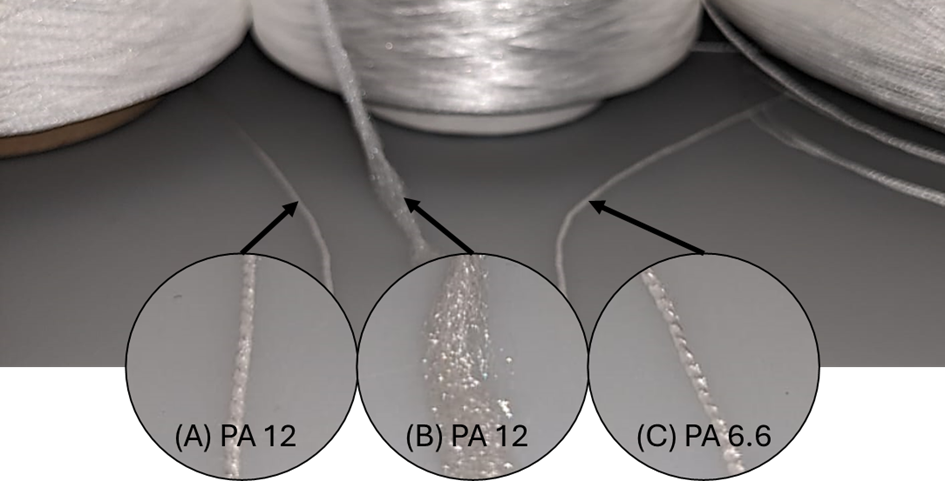
Figure 1: Comparative representation of PA 12 polar yarn after (A) and before (B) cabling and heat setting, and the benchmark product (C)
In the subsequent process steps, the ribbon yarns underwent heat setting in preparation for the weaving process, while the BCF yarns were cabled in pairs and then heat set. Since the processes investigated with the corresponding parameters have not yet been researched for PA 12, further intensive iteration loops will be necessary in the future. However, the results achieved so far clearly show that PA 12 has great potential for the development of an energy-efficient, dimensionally stable, and recycling-friendly monomaterial upper layer for textile floor coverings.
The research project is funded by the Federal Ministry for Economic Affairs and Energy (BMWE) as part of the Industrial Collective Research (IGF) program.
For further information on the project results, please contact the project manager, Ms. Susann Reuther (s.reuther@tfi-aachen.de).