

News-Archiv
TFI Aachen is a member of the Textile European Technology Platform (Textile ETP) and the New European Bauhaus (NEB)
TFI Aachen is very proud to be a part of Textile ETP and NEB.
Textile ETP is an international non-profit organization established in 2004. Its mission is to unite stakeholders across the entire textile value chain, helping Europe to achieve its goals and focus its priorities while strengthening the sector's competitiveness through meaningful partnerships.
The concept of the NEB started to form in 2020. It is a creative and interdisciplinary movement under the umbrella of the President of the European Commission that aims to shape a sustainable, inclusive and aesthetically pleasing future. By fostering participation and providing access to EU funding, NEB supports innovative projects that reimagine sustainable living across Europe and beyond.
With our active involvement in both organizations, we are seeking new collaborations to advance sustainable and circular change in the building sector as well as researching new areas of application for tufted textiles.
Our ETP Contact Person: t.schriever@tfi.aachen.de
Our NEB Contact Person: s.reuther@tfi-aachen.de
LEARN MORE
Textile ETP is an international non-profit organization established in 2004. Its mission is to unite stakeholders across the entire textile value chain, helping Europe to achieve its goals and focus its priorities while strengthening the sector's competitiveness through meaningful partnerships.
The concept of the NEB started to form in 2020. It is a creative and interdisciplinary movement under the umbrella of the President of the European Commission that aims to shape a sustainable, inclusive and aesthetically pleasing future. By fostering participation and providing access to EU funding, NEB supports innovative projects that reimagine sustainable living across Europe and beyond.
With our active involvement in both organizations, we are seeking new collaborations to advance sustainable and circular change in the building sector as well as researching new areas of application for tufted textiles.
Our ETP Contact Person: t.schriever@tfi.aachen.de
Our NEB Contact Person: s.reuther@tfi-aachen.de
TFI successfully completes research project BioBase
For key sectors of the textile industry in Germany (sports, interior and automotive textiles), established, petroleum-based benchmark products made from polyethylene terephthalate (PET), or recycled PET were successfully recreated in the BioBase project using the biopolymers PA 4.10, PA 5.10, PA 10.10 and PA 12. The textile value chain was successfully traversed from the polymer to the textile surface. With the aim of developing bio-based alternatives from already available resources for textile applications and properties, the BioBase project takes up the vision of the BIOTEXFUTURE innovation area - the conversion of the textile value chain from petroleum-based to bio-based. The BioBase project was funded as part of the ‘National Research Strategy BioEconomy 2030’ in the BIOTEXFUTURE innovation space. An overview of the project results can be found in the sample catalogue, which is available for download on the project homepage.(https://biotexfuture.info/wp-content/uploads/2024/07/Musterkatalog-Biobase.pdf)
https://biotexfuture.info/projects/biobase/
LEARN MORE
https://biotexfuture.info/projects/biobase/
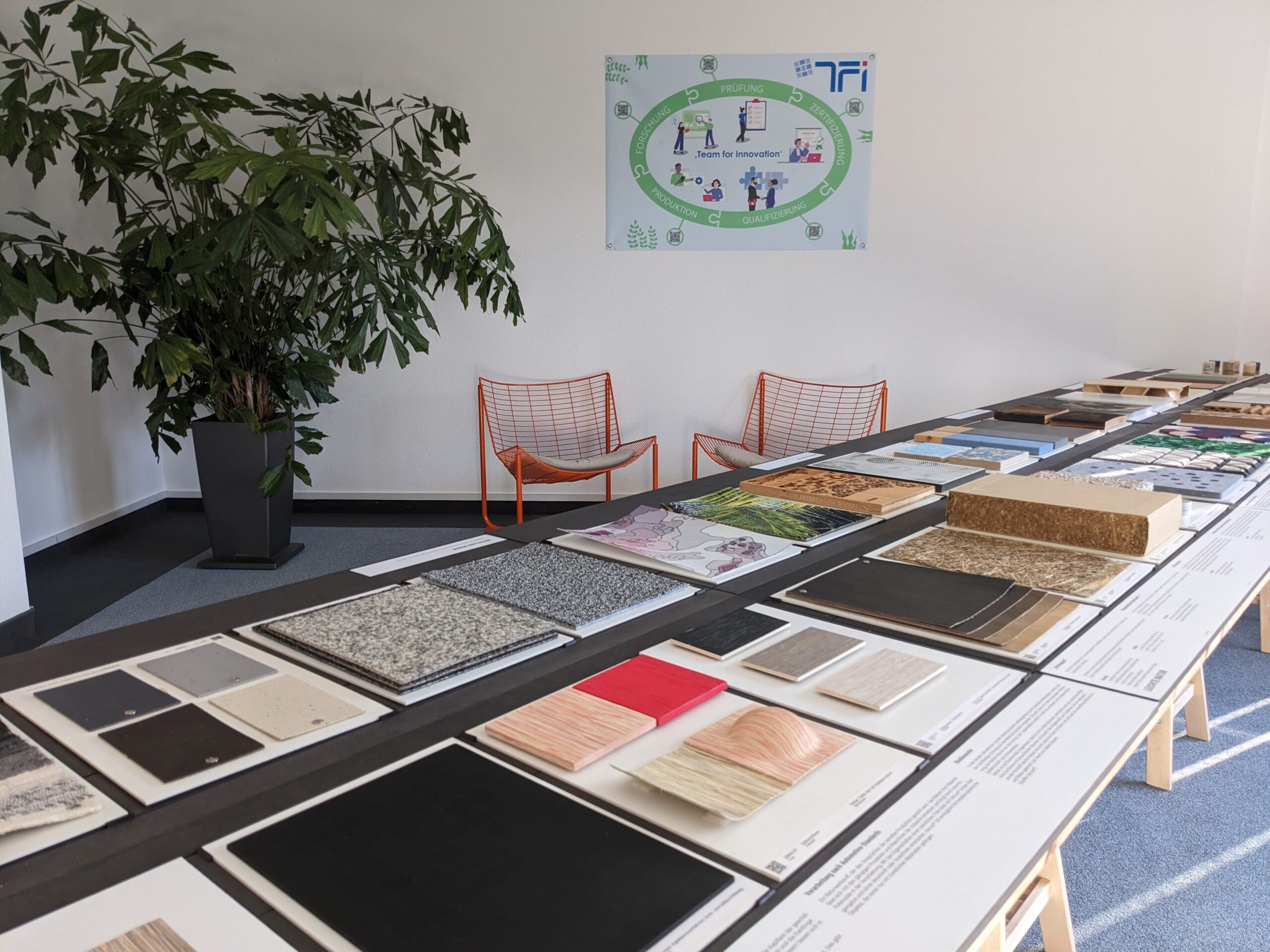
See, feel, get to know – showrooms at the TFI
Welcome to the new showrooms at TFI, your platform for exchange and inspiration. In our first showroom, we present samples and demonstrators from current and completed research projects with a focus on sustainability and technology development. The second showroom shows temporary external exhibitions; currently "Healthy Materials" by RAUMPROBE Materialbank, which presents innovative and environmentally friendly building products. Our showrooms promote inspiration and cooperation and offer companies a platform to present new products and technologies. Visit us and let us inspire you!
LEARN MORE
TFI successfully completes research project
For this purpose, innovative bicomponent yarns with a core made of conventional polyamide 6 and a shell made of phosphorus-modified polyamide 6 were developed. The tufted textile floor coverings could be bonded using a hot melt adhesive, so that the wear layer and backing could be separated after usage. Based on the results of the Radiant Panel fire tests, the floor coverings developed in this way were able to achieve a fire class (Bfl-s1) suitable for official buildings. Two demonstrators were tested in a practical section and after three months of use, no change in appearance or delamination of the back could be detected. The wear layer and the backing were successfully separated using a hot calender.
LEARN MORE
TFI successfully completes research project
Innovative helix yarns with a metal core and a corresponding acoustomechanical cleaning process were developed.
The helix yarns consist of a metal core surrounded by carpet yarns in a two-stage, counter-rotating reversing direction. In addition, a new type of pile fixation and backing coating was developed.
Suitable process control was determined for acoustomechanical cleaning. The helix yarn structure with metal yarn has a positive effect on the cleaning effect.
The findings were scaled up to a functional model and improvement approaches were formulated. The potential for a doubling of surface area performance and a significant reduction in the use of cleaning agents and water was identified.
LEARN MORE
The helix yarns consist of a metal core surrounded by carpet yarns in a two-stage, counter-rotating reversing direction. In addition, a new type of pile fixation and backing coating was developed.
Suitable process control was determined for acoustomechanical cleaning. The helix yarn structure with metal yarn has a positive effect on the cleaning effect.
The findings were scaled up to a functional model and improvement approaches were formulated. The potential for a doubling of surface area performance and a significant reduction in the use of cleaning agents and water was identified.
TFI starts a new research project
What influence do yarns have on the acoustic effectiveness of textile surfaces in a room? How to test the acoustic effectiveness of yarns? Is it possible to specifically influence the acoustic effectiveness through the yarn construction?
The “Acoustic Yarns” project is addressing these and other exciting issues. Further insights can be found on the project homepage.
LEARN MORE
The “Acoustic Yarns” project is addressing these and other exciting issues. Further insights can be found on the project homepage.